AbstractMoe, in the strict sense, is recently coined Japanese slang describing certain types of cute, mostly young and female anime (Japanese animation) characters. The word also functions as a label for the emotional response of anime fans to such characters.
Moe characters are neotenous, relative to actual humans, exhibiting juvenile traits at maturity.
Moe imagery is a supernormal stimulus that evokes a potent mixture of emotional responses in susceptible viewers: nurturing or protective feelings as well as romantic or erotic love.
Moe imagery may be thought of as a sort of recreational memetic drug, which produces pleasurable mental states in the absence of the proper stimuli for such states. The conventions of
moe art have been evolving since at least the 1970s, in a largely unconscious process driven by selection pressures favoring styles capable of eliciting these positive emotional responses in viewers.
I
ntroductionMoe (
萌え; two syllables: “moh-eh”) is an easily grasped, intuitive concept for fans of Japanese animation and related art forms, but devilishly tricky to define in a concise, complete and unambiguous manner.
Moe,
sensu stricto, describes a certain type of stylized illustration of a young, cute, innocent, most often female human (Fig. 1). The word also can be used for the emotional response that such illustrations trigger in viewers who enjoy
moe imagery.
Moe frequently functions as an adjective, but can be used as a noun, verb or interjection.
 Fig. 1.
 Suzumiya Haruhi no Yuuutsu (The Melancholy of Harhuhi Suzumiya)
© 2006 Nagaru Tanigawa/Noizi Ito/Member of SOS.
Originally a Japanese verb meaning to germinate or sprout,
moe was hijacked for the slang usage described here by anime, manga (Japanese comics) and game fans in Japan sometime in the late 1980s or early 1990s (
Japanese Wikipedia), and has only come into widespread use since 2000 (and ca. 2004 or later in the English speaking world). The range of situations where otaku (fans) might employ the word has since expanded almost to the point where it has become meaningless—anyone or anything that might provoke some kind of positive emotion can be called “
moe”—but for the purposes of this essay I will employ the narrow definition given above. Real, three-dimensional persons and things may be described as
moe, and the meaning is more or less clear, but this strikes me as an abuse of the term: there are perfectly good existing words, in Japanese and English, for the feelings we have for actual friends, relatives and significant others, or non-anthropomorphic objects like trains. I won’t consider the possibility further here, but calling celebrities, or other people who are not personal acquaintances, “
moe,” strikes me as being closer to the core meaning of the word: a famous actress is hardly more of a real, three-dimensional presence for her fans, than an anime character is for an otaku.
English-language analysis of the
moe phenomenon is sparse, but there have been some illuminating writings in the young field of moetic studies.
Wikipedia provides basic information, and John Oppliger (“Ask John” of AnimeNation) has written about the subject several times (providing a
definition, discussion of
moe in America, and some thoughts on
male moe). Shingo of Heisei Democracy presents an eloquent
overview of the subject, including a taxonomy of
moe. He also discusses narrative aspects of
moe that I will disregard here, not because they are unimportant, but because I wish to focus on visual aspects of
moe that I consider to form the underlying basis of the concept.
Manga artist Ken Akamatsu has written about his
theory of moe characters (translation courtesy of Matthew Whitehead), as has Japanese
moe fan
Tenkaise. Both are concerned with
moe as an expression of idealized, maidenly femininity: they believe that
moe characters are first, and perhaps exclusively, targets for paternal or maternal instincts. The American sources cited above (Oppliger and Shingo) are more inclined towards a concept of
moe that includes a sexual component.
Here, I attempt to analyze the
moe phenomenon from a biological perspective. I will confine my discussion to
moe sensu stricto: two-dimensional art with characteristics that would be recognized as
moe by enthusiasts. I will further restrict my consideration to the visual components of
moe works, although I think that a parallel case for the biological basis of
moe story elements or anime voice acting could be constructed, with few modifications. I focus on illustrations of female characters, intended for a predominantly male audience, because this is the most prevalent form of
moe. Again, a broadly similar explanation might be crafted for male
moe characters, which are a small but perhaps increasingly important part of the
moe art scene.
I should express some caveats before proceeding. What follows is nothing more than armchair speculation, based on my own experiences with
moe art, and conversations with others interested in the subject. My knowledge of neuroanthropology, ethology, sociobiology or other relevant subjects is strictly that of a layman, and I have not conducted any actual research into the application of these fields to moetic studies. That being said, I have taken pains to frame my ideas in terms that are potentially testable; that could be clearly, objectively supported—or refuted—by observation and experiment.
Furthermore, while I have tried to keep my discussion evenhanded and emotionally neutral, I realize that
moe is a subject that is likely to provoke visceral reactions, either positive or negative, in readers. I would hope that anyone who has read to this point would be willing to consider the material in a purely academic spirit: I am attempting to explain the appeal of
moe, not to pass judgment on the art style, or its partisans or detractors.
I. Moe Characters are Neotenous. Moe characters are highly simplified, stylized representations of human beings. Some of the features typical of the art form are common to nearly all representations of humans in animation, comics and videogames, and have straightforward practical explanations: it is easier to draw faces without wrinkles, moles, etc., than it is to draw faces with these added complications.
Other differences between
moe illustrations and more realistic portrayals of humans cannot be ascribed to mere labor saving measures, and indeed may add effort to the illustration process. Taken together, these special differences between a typical human and a
moe character of comparable age define the
moe style. Most obviously, the characters have large, rounded eyes with exaggerated pupils and irises, small mouths with de-emphasized teeth, thin lips, and noses that are reduced to the point where they are more suggested than drawn. Facial features are soft and rounded, and the head is large in proportion to the body (Fig. 2). Bodily proportions are often, in contrast, more or less natural, with secondary sexual characteristics developed as appropriate to the age of the character (mid to late teens, in the typical
moe title). Other stylistic modifications are less frequently mentioned, but important: the face is foreshortened, with less distance between mouth and eyes than would be present in a human. The hair of
moe characters is drawn using techniques to suggest extreme fineness (often appearing transparent if it overlaps the eyes, for example).
 Fig. 2.
 Shuffle!
© 2004 Navel.
This list of
moe traits can be neatly summed up by a single word: neoteny. In evolutionary biology, neoteny is the expression of the juvenile characteristics of an ancestral population, in sexually mature individuals of a descendent population, as a result of certain types of alterations to development (D.J. Futuyma. 1986. Evolutionary Biology, Second Edition). Humans are, in a well-known real world
example, neotenous relative to our ancestors, who, based on evidence from the fossil record and comparative morphology, shared many similarities with the extant nonhuman great apes. The relatively large head and foreshortened facial features of an adult human are neotenous, and are strictly juvenile characteristics in apes. In a poetic sense at least, one might say that
moe is an artificial extension of long-term trends in hominid evolution. Toy dog breeds are another biological manifestation of neoteny. Adult toy dogs retain certain puppy-like aspects—such as relatively short muzzles and large eyes—as a result of the action of centuries of selective pressures favoring cuter animals for use as pets. (Fig. 3).
 Fig. 3. Cavalier King Charles Spaniels and many other toy dog breeds show morphological modifications analogous to those seen in
 moe
illustrations. Photo © 2007 M. Opel characters are neotenous relative to their “ancestral state,” which can be taken to be actual humans or naturalistic illustrations thereof. All of the
moe characteristics I list—eye size, facial proportions, hair texture—are features of immature humans, which are conserved even in otherwise mature
moe characters. The end result—an adult human, realistically rendered in certain respects but with other aspects indicating incongruous youth—is arresting, and for some viewers deeply appealing. Of course, neoteny in
moe illustrations is only an analogy: actual neoteny involves alterations to the developmental trajectory of individual organisms, as a result of many generations of cumulative genetic change in a population, whereas anime characters are not subject to the laws of population genetics, and lack developmental trajectories.
A useful first step towards developing a rigorous, experimentally based understanding of
moe might be to develop an experimental library of new
moe imagery, with various characteristics of the images systematically varied, and have a large sample of enthusiasts rate the results for their
moe qualities. I would expect that characteristics like the size of the eyes, the angularity of facial features, and the distance between eyes and mouth would be critical and very sensitive determinants of an image’s perceived “moe-ness.” Hair length, eye color or clothing style should be, on average, almost irrelevant.
The important characteristics of
moe illustrations could be plotted against fan response to obtain a graphical overview of what qualifies as
moe. The result would be a probabilistic map of the position of
moe in the “Design Space” (D.C. Dennett. 1995. Darwin’s Dangerous Idea) of all possible illustrations of human figures, based on observable quantitative or qualitative characteristics (Fig. 4). I would expect that dozens of different characteristics (corresponding to different axes on a graph of Design Space) would need to be measured to distinguish
moe art from other styles with any degree of certainty. Thus, in practice,
moe would constitute a hypervolume within the multidimensional Design Space of human illustration. Knowledge of the position and shape of the
moe hypervolume would be required for further investigations into the appeal and development of the style, as I will discuss below.
 Fig. 4. Hypothetical two dimensional section through the higher-dimensional Design Space of illustrations of human figures. Darker colors indicate higher probabilities that an illustration will be perceived as
 moe
. In the middle of the last century, Niko Tinbergen and Jack Hailman conducted experiments on the food-begging behaviors of herring gull chicks. They constructed models of the heads of parent gulls of various degrees of realism, and some with odd modifications, and recorded how enthusiastically the chicks responded (Fig. 5). These experiments are memorable for various reasons: there is an element of slapstick to the setup, for one thing. But, the results tell us important, and perhaps vaguely unsettling, things about how the vertebrate central nervous system integrates and responds to stimuli. As one might expect, many of the unrealistic models provoked little interest from the chicks. But one, just a yellow stick with horizontal red lines, actually elicited a greater response than a real parent gull. An artificial stimulus that evokes more of a response than the natural stimulus has been termed a “supernormal stimulus.”
 Fig. 5. Models employed by Tinbergen and Hailman, with response intensity indicated by red bars. The simple stick with three lines is a supernormal stimulus. © 1986 W.T. Keaton & J.L. Gould. Biology, 4th Edition.
An intriguing interpretation of the behavior of herring gull chicks in response to the stick-with-lines, is that the chicks are on some level aware that the stick isn’t part of a real parent bird, and that they won’t be fed no matter how much they peck at it. Responding to the supernormal stimulus might be irresistible simply because it feels good to do so. In this interpretation, the supernormal stimulus is analogous to a recreational drug, which the chicks seek out because it alters activity in their brains in a pleasurable way, quite apart from any expectations of material rewards. I can’t say if the central nervous system in herring gulls is really capable of that sort of subtlety, but the central nervous system in humans certainly is.
The paintings of Pablo Picasso are sometimes cited as examples of supernormal stimuli in
Homo sapiens, though the sort of response they might be triggering seems awfully ill defined. In a sense, many aspects of the portion of human culture we classify as art or entertainment could be regarded as supernormal stimuli, intended to provoke outsized mental or physical responses that parallel our responses to people, animals, landscapes and other real objects in the natural world.
Moe art is arguably a particularly clear and compelling example of a human supernormal stimulus, which triggers specific primal mental activities in a straightforward way.
There is some variation in the way that the mental responses of enthusiasts to
moe images is reported. It does, however, seem to be agreed that it is positive and emotionally charged, and that it is a social response, akin to feelings normally provoked by contact with other human beings, and not at all similar to the sort of appreciation that one might have for a flower or a colorful sunset. Given the reports I have heard and my own experience, and taking into account the concept of
moe above (
moe imagery intended for a male audience involves abstract neotenous portrayals of human females), I contend that
moe is a supernormal stimulus for both nurturing emotions and sexual feelings:
moe characters appear youthful, in need of nurturing and protection, and at the same time attractive as potential romantic partners. The illustrations achieve this result through a combination of physical cues for nurturing and sexual responses that are not expressed together in any actual human phenotype.
In mainstream forms of
moe the sexual aspect is often secondary or nearly subliminal—popular
moe anime and manga franchises are often astoundingly chaste compared to, e.g., teen romantic comedies produced in America—but it is always present at some level. Over the range of styles that are classified as
moe, nurture and eroticism exist in varying proportions, and there seems to be an inverse relationship between them: actually pornographic
moe works (mostly computer games, or fan productions) deemphasize nurture, while in titles with young, nurture-inspiring characters, eroticism tends to be rarified and innocent to the point of invisibility, existing as a vague future potential (Fig. 6).
 Fig. 6.
 Azumanga Daioh
© 2002 Kiyohiko Azuma/Mediaworks/Azumangadaioh Committee. The response of
moe enthusiasts to the images undoubtedly has many forms, and people clearly get more out of
moe works than gut feelings of nurturing and erotic love. Depending on the viewer and the specific work,
moe characters might act as vessels into which the viewer’s own insecurities can be projected (see
SDS’s essay at Heisei Democracy), or the focus of nostalgia for social and sexual mores that they imagine to have held sway in the past. The characters might be incorruptible symbols of a longing for eternal youth and beauty, or poignant reminders of the transitory nature of life and happiness, or any number of other things. But, I would argue that the nurturing/erotic aspect of
moe appeal is foundational—both necessary and sufficient—and that other aspects of the relationship between
moe character and viewer are optional elaborations built on this foundation.
In principle it should be possible to test the idea that
moe images elicit feelings of nurturing and erotic love in viewers. As a first step, a sample of
moe enthusiasts and non-enthusiasts could simply be asked about their emotional responses to a range of test images of varying degrees of moe-ness. Care would need to be taken in selecting images and crafting a questionnaire, to minimize ambiguity and confounding factors. The mere fact that enthusiasm for
moe is far from universal, even among otaku, could provide a way of testing ideas about the underlying nature of the style’s appeal. If there are consistent psychological differences between
moe fans and non-fans, an examination of the personality traits of the two groups might provide clues to the mental mode of action of
moe imagery.
Brain scanning technology, such as functional magnetic resonance imaging (fMRI), might provide a more direct way of assessing mental responses to
moe images, if emotional states such as nurturing love or romantic love can reliably be interpreted from such scans. Current brain imaging techniques might not be up to the challenge of distinguishing these sorts of emotional responses, which are, after all, frequently intertwined in the real world, but the technologies are advancing rapidly.
Looking back to the herring gull experiments, it is interesting to note that the supernormal stimulus bears almost no resemblance to its corresponding normal stimulus, as far as we humans are concerned: if you were shown the stick-with-lines in Fig. 5 without explanation, there would be little chance that you would guess that it was a stylized representation of a herring gull beak. But it looks very much like a beak, and in some sense more like a beak than a real beak, if your brain is wired like a herring gull’s. Similarly, modern
moe imagery is so stylized that I wonder if the proverbial anthropologist from Mars would even realize that it was meant to represent human figures. Our brains are predisposed, even eager, to recognize human forms in visual information. To a brain not specifically evolved to respond to the sight of human faces,
moe characters might not even be recognized as human, unless some helpful earthling pointed out that, yes, that is supposed to be a nose, that represents hair and those are the eyes. It is (perhaps barely) possible to explore the issue of how
moe supernormal stimuli would be perceived by nonhuman minds through experiments with animals, trained to respond in different ways to pictures of humans vs. pictures of other animals or objects. How would an appropriately trained chimpanzee, for example, classify a
moe illustration: as human, as chimpanzee, or as something else; as living or non-living? Under the supernormal stimulus hypothesis, it is expected that nonhuman animals would have more serious difficulties in interpreting
moe images, compared to naturalistically proportioned but still stylized illustrations of humans.
III. The Moe Style is a Product of Rapid and Recent Memetic Evolution. The word
moe may have only come into common usage since the new millennium, but the characteristics of
moe illustration have a relatively long history in Japanese pop-cultural visual arts. Indeed, most of the elements were in place, if not often combined or developed with any degree of sophistication, by the 1970s. Exaggerated facial features typical of
moe, like big eyes and small mouths, defined the look of certain characters in what older American fans called Japanimation, decades before anyone had a convenient label for the style. If I may indulge in a little gratuitous jargon coinage, earlier works with some
moe characteristics might be termed promoetic (“before
moe”)(Figs. 7-10), while modern (mostly post-2000) works with highly developed
moe characteristics are eumoetic (“true
moe”)(e.g. Figs. 1-2).
 Fig. 7.
 Neon Genesis Evangelion
© 1995 GAINAX/Project Eva.The story of how promoetic physiognomies came to prominence in Japanese animation and comics is a subject for another essay. One argument, just for example, is that unnaturally large eyes were adopted as a simple means of making character emotions easier to portray. It is sufficient for my purposes to note that there arose a community of dedicated, adult or young adult connoisseurs of promoetic character designs, and that some of these fans, inevitably, developed pseudo-romantic feelings for their favorite characters. In the mid or late 1970s—which saw the rise of a fanatical following for
Uchuu Senkan Yamato (
Space Cruiser Yamato/
Star Blazers, 1974)(Fig. 8), and the publication of the first dedicated anime magazine, Animage (1978)—the fan community reached a critical mass. Selection pressure in favor of characters with which the audience could feel certain kinds of deep emotional attachments came into play in the anime and manga industry, and an evolutionary path leading to the eumoetic style was opened.
 Fig. 8.
 Uchuu Senkan Yamato
© 1974 West Cape Corporation.
The study of the evolution of ideas and cultural information, as a process analogous to biological evolution, has been termed memetics. A meme is some piece of information, such as a method for drawing eyes in animation, that according to the memetic hypothesis acts as a unit of heredity similar to a gene in biology (R. Dawkins. 1976. The Selfish Gene). A meme is replicated if it is imitated, and thus copied to another human mind. Replication may be imperfect, giving rise to memes that are variations on the original. If there are differences in the tendency of variations of a meme to be copied to new minds, a process similar to evolution by natural selection can occur, and variant ideas that are especially good at getting replicated can come to dominate the cultural landscape. Memetics is a science in its infancy, and the extent to which memes are similar to genes, and indeed the extent to which memetics can be made into a useful model of changes in human culture, is hotly debated. However, I would argue that memetic theory provides an informative perspective from which to think about the development of
moe art, and that the history of
moe is a potentially tractable subject for a formal study in memetic evolution.
In the promoetic “entangled bank” (Darwin's memorable description of the arena of biological natural selection) of 1970s Japanese two-dimensional visual culture, a very large number of memes about how to draw animation characters competed with each other for habitat: space in the minds of artists who would implement them with pen, paper, paint and cels. Those memes that succeeded—that were incorporated into works that attracted a large following—were replicated, sometimes with modification, by the minds of new artists. Something similar to natural selection could occur if certain techniques produced results that were in some manner more likely to be imitated: some illustrations were more appealing, more memorable, or simply easier to copy than others (Fig. 9).
Moe evolved because significant numbers of television viewers, buyers of books and videos, and artists themselves found an appeal in characters whose appearance elicited the pleasurable emotional responses of nurture and erotic love.
 Fig. 9.
 Urusei Yatsura
(Those Obnoxious Aliens) © 1983 Kitty Films.A perhaps counterintuitive feature of the memetic theory of
moe evolution is that it does not involve any awareness of the fundamental reasons why
moe art is appealing, on the part of the artistic community within which the style originated. For example, artists would have recognized, consciously or not, that decreasing the distance between mouth and eyes relative to the height of the head made a character look younger, cuter, more lovable, or for the pragmatists, more marketable to a certain audience. The artistic utilization of this effect almost certainly did not involve any sort of academic contemplation of mental states engendered by the viewing of characters with foreshortened faces. The origin of this sort of meme may have even been accidental, the result of a novice cartoonist who didn’t understand how to properly draw a face stumbling onto an alteration of normal human proportions that produced a positive response in viewers.
Another feature of a memetic theory of
moe would be that the evolution of the style did not proceed towards a set, preconceived goal in the minds of those in the artistic community: it was unplanned, its trends and direction identifiable only in hindsight. In other words, the types of derived
moe character designs that are dominant today would have been literally inconceivable 30 years ago. There were thousands of talented men and women working in anime and manga in 1980, but none of them could have sat down and drawn something approaching a modern eumoetic illustration. Such illustrations are the product of decades of memetic replication, variation and selection in response to pressures that were understood dimly, if at all, at any given time in the
moe evolutionary trajectory. This is not to minimize the individual creative achievements of the artists who have contributed to that evolution; the overall development of the style, however, proceeded without foresight or conscious planning.
Empirical testing of a memetic theory of the origin of
moe would need to build upon the sort of research proposed in earlier sections of this essay. One would need, at minimum, an understanding of how the measurable morphological features of a two dimensional character contribute to its average perceived moe-ness: a map of
moe in Design Space (Fig. 4). Armed with this knowledge, a researcher could begin gathering data on the evolution of the morphological features critical to moe-ness in the wild: in the vast quantity of anime, manga, games and books that have been released over the past 30-40 years (Fig. 10).
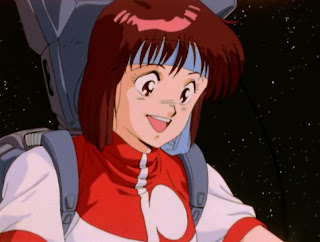 Fig. 10.
 Top o Nerae! Gunbuster (Aim for the Top! Gunbuster)
© 1988 GAINAX/Bandai Visual/Victor.Rates and trends in
moe evolution could be quantified, as could the contributions of individual artists. If
moe is truly a memetic phenomenon, it is expected that no individual or short list of individuals has driven changes in the style; sources of innovation should instead be distributed more or less throughout the entire artistic community. When the evolution of anime art styles over time is followed in Design Space, the path to
moe should be seen to proceed smoothly, incrementally, and not via a series of abrupt leaps into new and unexplored territory.
Since
moe is such a recent innovation, many of the artists who have contributed to it are still living, and could be interviewed about their influences, and their motivations for adopting
moe. Under the memetic hypothesis, the artists should show little understanding of why they were attracted to the conventions of
moe, and no evidence of having planned the development of the style.
A serious—but potentially non-fatal—difficulty in studying memetic evolution in
moe is the problem of identifying lineages of artistic style, analogous to evolving populations of organisms in biology. The potential for rampant horizontal transfer of memes between stylistic lineages would complicate analyses, for instance. Furthermore, even within a single title created by one artist, there quite possibly exist both
moe and non-
moe characters. One way of defining the main
moe lineage might be to consider only those characters (from any title or artist from a given time period) whose measured morphology indicates proximity to the modern
moe hypervolume in Design Space. The threshold position in Design Space would be relative to all other works at a given time, and the absolute value of the cutoff would be predicted to gradually approach closer and closer to the position of eumoetic illustrations. Another approach would be to analyze the genres and types of characters (which may be surprisingly consistent and identifiable over time and across creators) that are known to be the most
moe: for example, high school age girls in romance/comedy anime marketed to boys.
IV. Conclusions: Whither Moe? In the event that researchers completed the sorts of studies that I have outlined here, further avenues for investigation would open. For example, anyone who has been following the anime world closely for the past few years probably has the sense that he or she has at least a general idea of what
moe is about and what sorts of drawing styles are possible in the genre. The number of possible
distinct moe designs is nearly infinite, but all the remaining potential designs might be minor variations on themes that have already been visited. However, it isn’t at all clear that the space within the present
moe hypervolume has been thoroughly explored; there may be large gaps, distinct types of designs within moe-space that produce the appropriate psychological effects, which have never been realized by artists. These gaps, if they exist, might even be revealed by a sufficiently detailed map of the
moe landscape.
 Fig. 11.
 Lucky Star
© 2007 Kagami Yoshimizu/Lucky Paradise. Moreover, we cannot say that the evolution of
moe through Design Space is finished. It is tempting to think that
moe has more or less reached its local peak of memetic fitness, and that any further modification of the illustrations would leave them less able to function as supernormal stimuli for nurturing urges and feelings of romantic love. Indeed, the more extreme current examples of stylization in the art form (Fig. 11) impress me as probably being near the edge of the theoretical
moe hypervolume; if they were moved much further away from the space of naturalistic human representations, they would be too strange to provoke emotional responses in most viewers. However, the future path of evolution in complex systems is contingent on many unknown factors, and difficult to predict: my instinct that
moe has settled onto an optimal configuration of stylistic modifications might easily be proved wrong, as the next generation of artists explores the present limits of
moe illustration, and perhaps opens a path into uncharted regions of Design Space.
Matt Opel
Storrs, Connecticut, February 12, 2008

 It's kind of a slow spring, anime wise. There are 46 new shows premiering, which is, admittedly, too many for any normal human to follow. But, that's down by a third from spring seasons a few years ago. There are a couple of big deal, big budget projects, such as Macross Frontier and Code Geass R2, but as spinoffs from popular franchises, these smell like safe choices for production companies shell shocked by broad economic woes as well as the corrosive effects of illegal downloading. While I'd say there are no truly outstanding new anime this season, a fair number of solid shows are coming out, and most viewers should be able to find at least a few items of interest.
 Bus Gamer
 Druaga no To - The Aegis of Uruk (The Tower of Druaga)
 Itazura na Kiss (Mischievous Kiss)
 Kamen no Maid Guy (Masked Maid Guy)
 Kanokon
 Kyouran Kazoku Nikki (Diary of the Frenzied Family)
 Macross Frontier
 Mnemosyne no Musume-tachi (Daughters of Mnemosyne)


 Posts
Posts

